
jbro

Technology Hasn’t Changed Love.

Helen Fisher’s Ted Summit talk “Technology Hasn’t Changed Love. Here’s Why.” (recorded June 2016 in Banff, Canada) discusses how, even though we have developed new ways to court each other using technology, the fundamental priciples of love remain the same. Helen discusses how our faster connections actually lead us to a new form of courtship… Read more »

Four Broad Temperament Dimensions

A new temperament construct based on recent brain physiology literature has been investigated using the Fisher Temperament Inventory (FTI). Four collections of behaviors emerged, each associated with a specific neural system: the dopamine, serotonin, testosterone, and estrogen/oxytocin system. These four temperament suites have been designated: (1) Curious/Energetic, (2) Cautious/Social Norm Compliant, (3) Analytical/Tough-minded, and (4)… Read more »

Neural Correlates of Four Broad Temperament Dimensions

Four suites of behavioral traits have been associated with four broad neural systems: the 1) dopamine and related norepinephrine system; 2) serotonin; 3) testosterone; 4) and estrogen and oxytocin system. A 56-item questionnaire, the Fisher Temperament Inventory (FTI), was developed to define four temperament dimensions associated with these behavioral traits and neural systems. The questionnaire… Read more »

Our first study of romance: the reward system

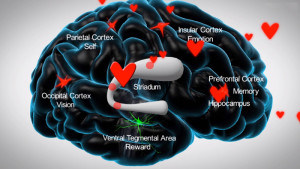
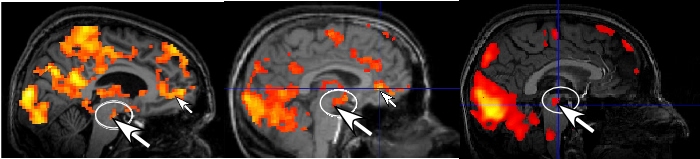
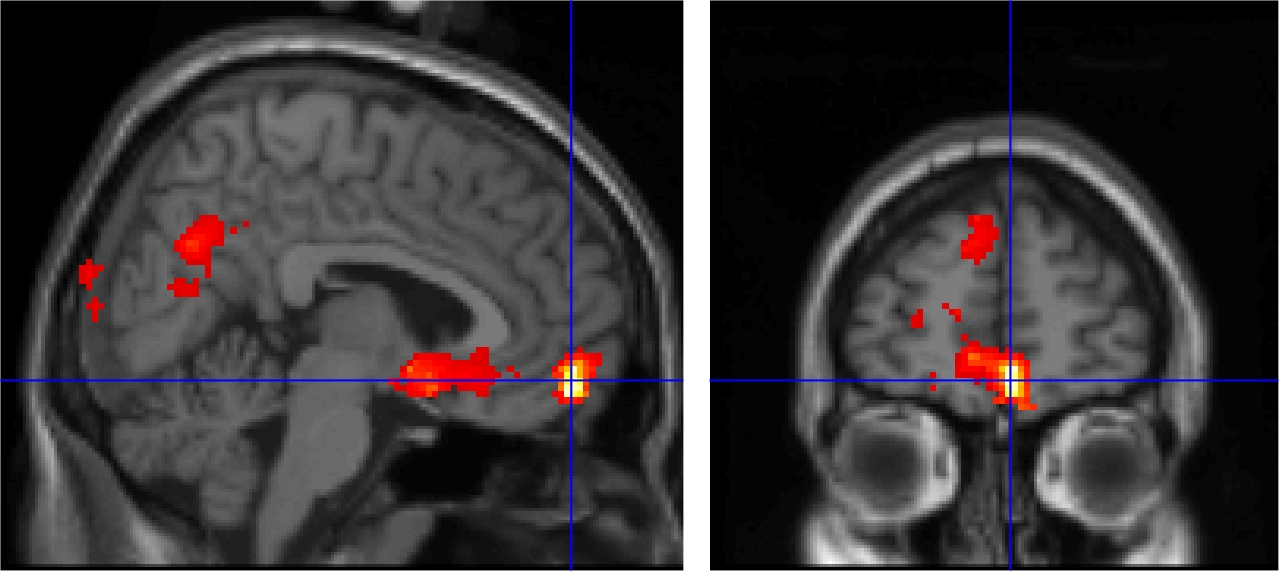
Early-stage romantic love, lasting a few months to a few years, is associated with the reward system. It shares the systems used in the brain for a primitive drive like thirst. This may be the reason it is so hard to control, and so engulfing. It is not our fault if we feel out of… Read more »

The Caudate and the correlation with the passionate love scale scores

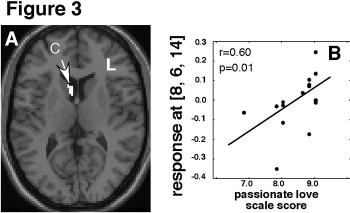
What does it mean that the activity in the caudate was correlated with the passionate love scale scores, but not the VTA?  Perhaps the VTA, mediating primitive “on/off” drives, may not measure love in degrees.  Maybe that is why when we’re in love, we are all in or all out.  The caudate, however, integrates much… Read more »

Just Another Pretty Face? Facial Attractiveness

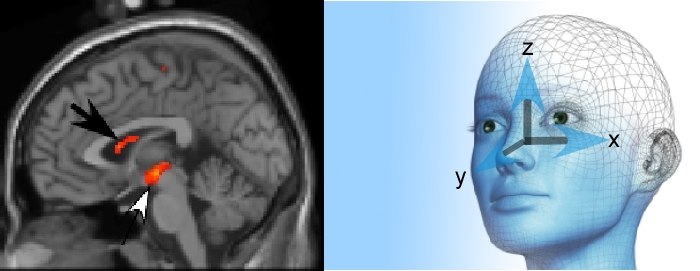
What areas of the brain are signaling, “He/she is good-looking!!” ? One area is the left VTA. When you’re out on that first date, is the left VTA active in your date when they look at you? As humans, we have a standard of attractiveness in faces and bodies.  There is a huge amount of… Read more »

Time and Romance

Six things that are important to a long-term relationship We asked Art Aron, our collaborator and a social psychologist, “What are the most important things investigators have found that promote good long-term relationships?” His answer was, “I have six things to tell you!”  He speaks to us in this short video, and here is a… Read more »

Falling in Love: the striatum

One of our ideas is that the striatum (also known as the caudate) is essential for falling in love.  The striatum has been considered an executive area of the brain.  It makes decisions like Stop and Go.  It may make the decision about who to love.  All of our thoughts and feelings associated with romantic… Read more »

Sex is Different from Romance

We think that there are different brain systems for sex, romance and attachment.  Indeed, sexual arousal is mediated by an area different from romance: the hypothalamus; and fMRI studies show activation in the hypothalamus is correlated with erection size in men.  Sex and romance often happen together, but often they don’t, too. We had asked our… Read more »

Gender and sexual orientation do not matter

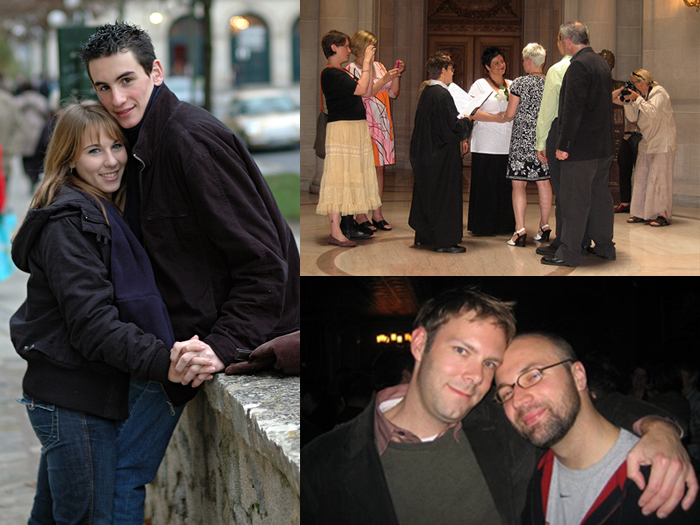
The VTA is active in romance no matter what your gender or sexual orientation. We are often asked if there is any difference between men and women in terms of what we see in the brain in love.  There really isn’t.  We were surprised at how similar men and women are, at least at this… Read more »

fMRI limitations

fMRI uses a signal that localizes changes in AVERAGE neural activity in 3 mm3 regions. fMRI has quite a few limitations when it comes to brain mapping.  The signal we pick up is not clearly one that reflects firing rate of neurons.  The signal is, instead, an average of metabolic demand over a 3 mm3… Read more »
Why Do We Suffer So?

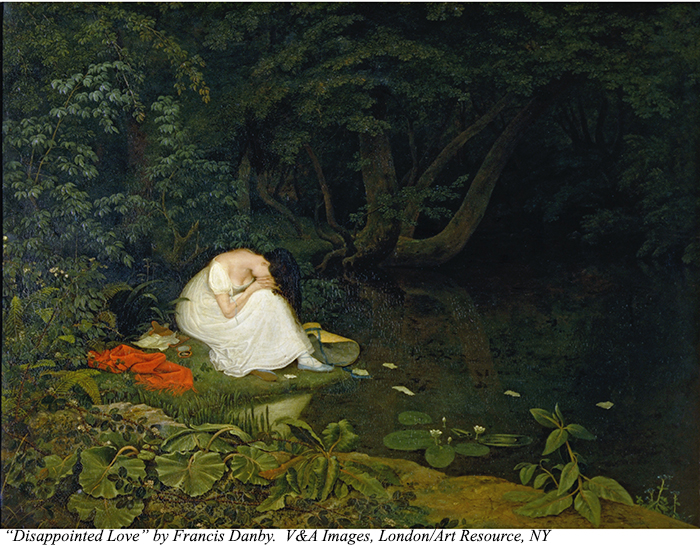
Around the world, some disappointed lovers slip into clinical depression; others stalk, murder or kill themselves.  As the Swiss writer Henri Frederic Amiel put it, “The more a man loves, the more he suffers.”  The Tamil peoples of South India call this state of romantic suffering “mayakkam,” meaning intoxication, dizziness and delusion.  And Poet John… Read more »

Recovering From Rejection

Wisdom from brain science Throw out the cards and letters.  Delete the emails and texts.  Put all the mementos of the relationship in a box and bury the container in a closet if you can’t throw it out.   Alcoholics who give up drinking don’t leave a bottle of vodka on their desk. Remove the photos. … Read more »

Addicted to Your Romantic Partner

The brain studies confirm that love can be described as an addiction.  It is a natural addiction.  Maybe drugs like cocaine just hop on the natural addiction systems needed for hunger, thirst, romance and attachment. Indeed, the passion we feel after rejection shows all of the traits of an addiction. Foremost, like all addicts, recently… Read more »

The Rejected Brain

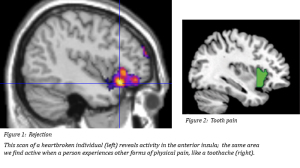
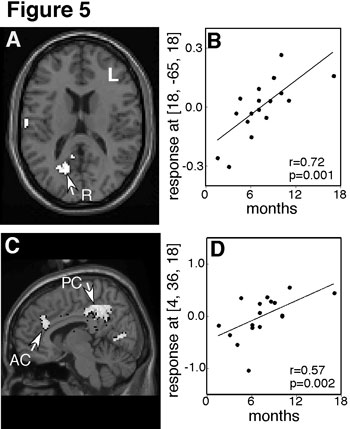
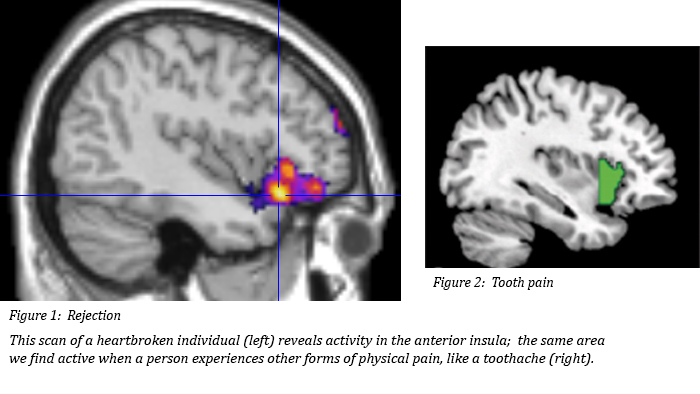
The brain studies show us that romantic rejection hurts just like physical pain, and it is like cocaine addiction.  We have to treat it like an addiction and think of it like a broken bone.  It will heal with time. It may even benefit from aspirin and other anti-inflammatoy medicines!  It’s important to go “cold… Read more »

Stages of Rejection

Psychiatrists have suggested that there are two general phases of rejection: Protest and Resignation. During the Protest Phase, men and women dedicate themselves to winning their partner back.  Restless energy, insomnia, loss of appetite (or binge eating), and obsessive thoughts about the beloved plague them.  Many sob; others drink too much, drive too fast, hole… Read more »